
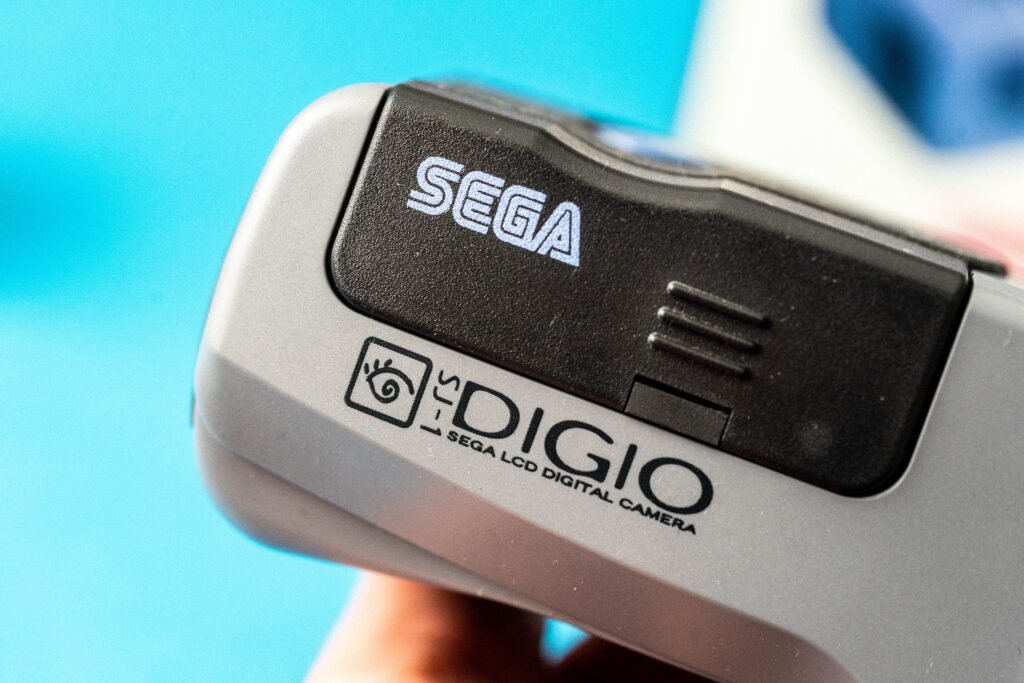
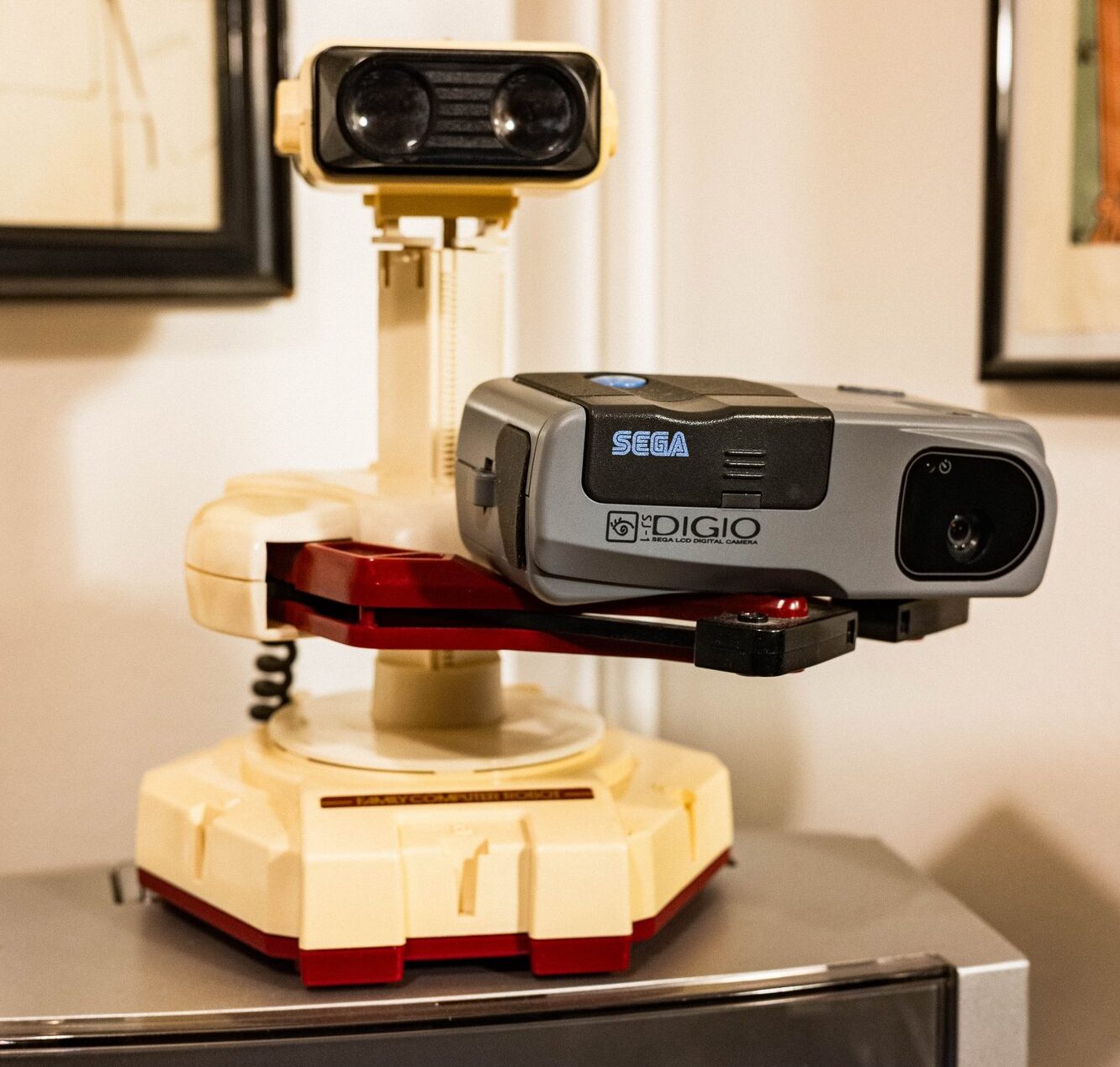
A Nintendo robot is holding a Sega Digio SJ-1 in one of my photographs. After all those console wars, this feels like a reasonably civilised outcome.
The Digio is a digital camera. Grey plastic, a big blue shutter button, and that familiar Sega logo on the front. My collection has plenty of cameras and plenty of Sega hardware, so this one was always going to find its way into the overlap.
By September 2025, I had a working one again, thanks to @superfamicomcollection. Getting the photographs off it involved drivers, old cables and vintage computers. Quite a support crew for a camera whose memory card holds half a megabyte.
The future, with instructions
Sega announced the Digio in September 1996, with a Japanese price of ¥29,800. Seeing that name on a camera feels strange even now. Imagine spotting it in a shop window among the usual photographic brands.
The box does quite a lot of explaining. There’s a diagram of the colour LCD, arrows pointing to the controls, and a separate illustration of the memory card. The Japanese wording calls it “digital film”, with SmartMedia underneath.
Digital film. I like that little bridge between the thing people understood and the thing they were being asked to buy.
There’s a dial for adjusting focus, with NORMAL and MACRO marked beside it, and a shutter button large enough to find without looking. The little colour screen is surprisingly decent, too. The whole thing has the slightly awkward proportions of something whose shape hadn’t quite been settled yet.
That focus dial even prompted a change before launch. Within a week of the announcement, Sega revised the closest focusing distance from 10 to 20mm. Its explanation was pleasingly practical: reaching 10mm took too many turns of the dial.
Half a megabyte, please
The blue card in my photographs is labelled 0.5MB. Half a megabyte, with a broad patch of gold contacts and a clipped corner. Even the card has a Sega logo on the other side.
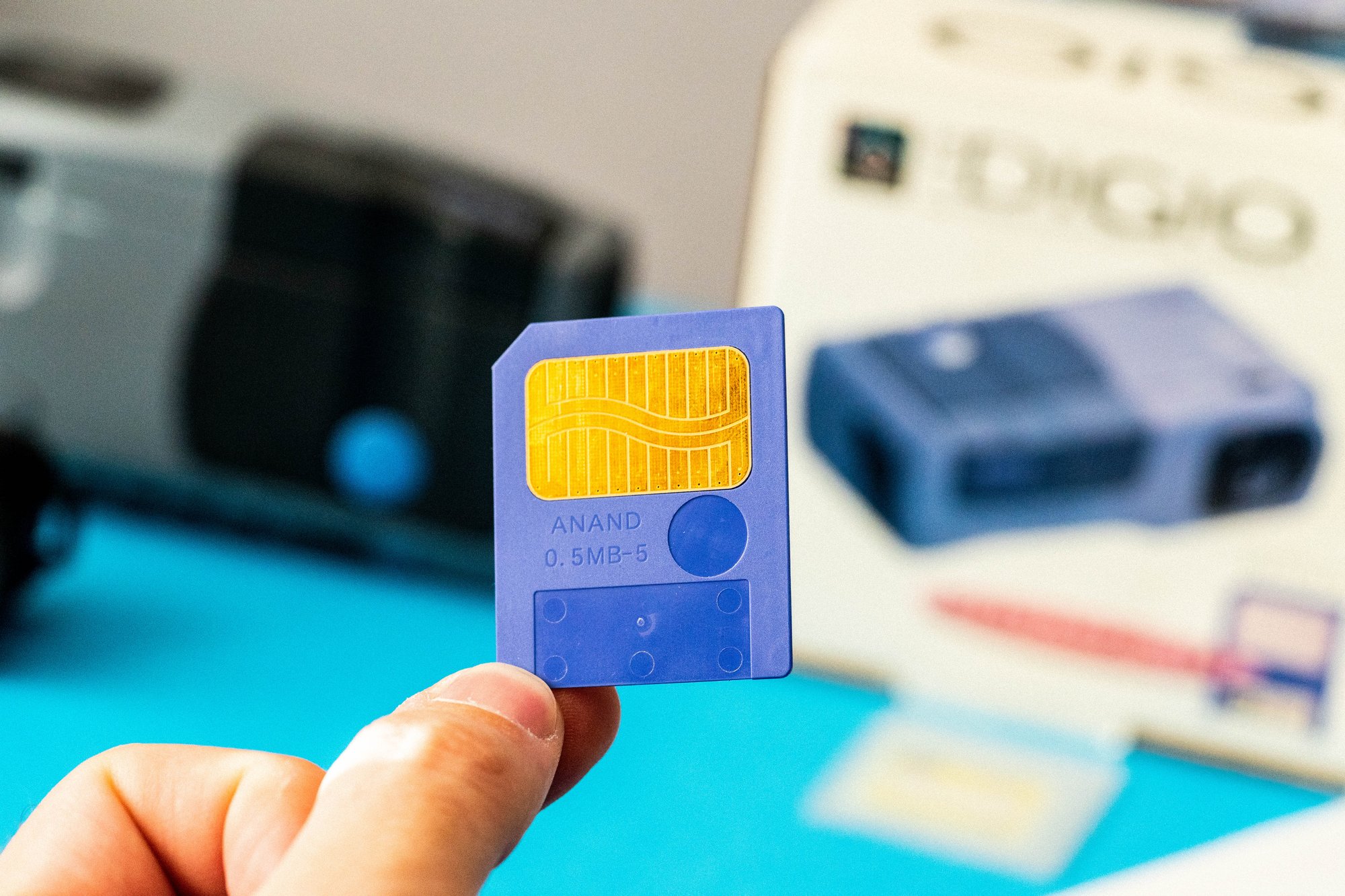
There’s something pleasing about being able to hold the camera’s memory between finger and thumb. You can see where the pictures live. Open the little door, take the card out, put it somewhere safe. Preferably somewhere you’ll remember.
The standard image measures just 320 × 240 pixels. You wouldn’t want to crop away much.
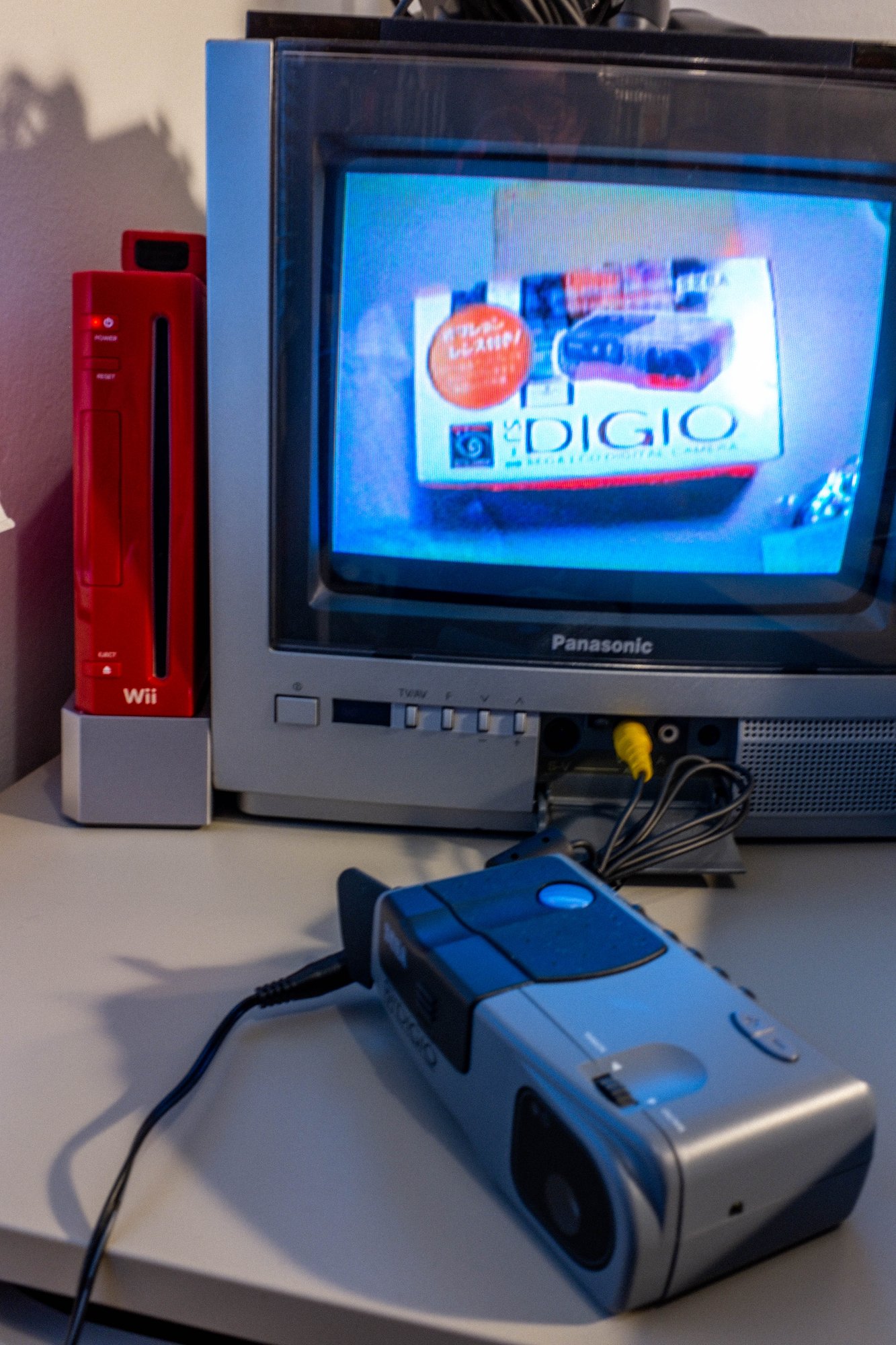
Then there’s the photograph of the Digio connected to a Panasonic CRT, with its own box appearing on the television. A camera pointed at the box it came in: a fairly accurate portrait of what collectors get up to when left alone.
On the curved screen, the packaging comes back soft and blue. You’re looking through the camera, the television and another photograph of that television, so it’s hardly a fair image-quality test. I like the scene anyway. The cable, the box, the picture filling a screen that could just as easily be showing a game.
Sega had more in mind for that television. Alongside the camera, it announced PictureMagic, a separate image editor with a tablet and pen. It was designed for combining Digio photographs and adding effects such as mosaics or reversed colours on the TV. Looking at my little CRT setup, I can see how an afternoon might disappear.
Room on the shelf
I love that grey-and-blue colour scheme. It reminds me of the Japanese Saturn, and I’d happily have seen Sega carry it across a whole family of machines. A Game Gear in those colours. A matching Dreamcast. Yes, I’d probably have wanted both.
At least the Nintendo robot seems to approve. There he is, holding it with both hands, considerably more prepared for the group photo than anyone else.
You can see the Digio in my short video on Instagram.
Stay curious. Stay nostalgic.
Because retro never dies, it just respawns.

Leave a Reply